Skip to Content

26.4 - On Critical Liberalism

Why Smith is more radical than we think

The oldest branch of liberal thought remains its most emancipatory.

It asks how everyday practices affect freedom, often without our knowledge. It treats power with relentless suspicion while it praises good law. It rejects fundamentalisms, celebrates basic virtues, and recognizes the limits of reason. It aims, above all, to prevent and ameliorate harm.

Call this critical liberalism.

It’s easy to miss our radical heritage. In 1960, Sheldon Wolin found, to his surprise, that the liberal stereotype—arrogant, naive, and “bewitched by a vision of history as an escalator endlessly moving upwards towards greater progress”—had little grounding in the early texts.

The critical mode of liberal thought resists such stereotypes. It runs from Adam Smith through Sophie de Grouchy, Judith Shklar, and Amartya Sen. Montesquieu prefigures it; Jacob Levy and Elizabeth Anderson, in their different ways, are developing it still.

Critical liberals share an aim and a method. They aim at liberation from oppression, cruelty, and abuse. They pursue that aim through a perspectival critique that interrogates power from below. 

Today, I want explore how Smith inaugurated the tradition. He not only named the “liberal plan of equality, liberty and justice”; he also asked how it feels when these goods are withheld. 


The real Adam Smith looks nothing like his caricature: apologist for avarice, patron saint of private equity. As Maria Pia Paganelli has catalogued, Smith denounced monopolies, protectionism, slavery, empire, colonialism, poor political representation, state religion, and academic sinecures, at a time when these pervaded British society. (How many are with us still?) At nearly every turn, we find a paramount concern for the vulnerable and dispossessed. This Adam Smith looks like a radical. 

He calls his Wealth of Nations “a very violent attack… upon the whole commercial system of Great Britain". Why? Because it served to enrich the few at the expense of the many. Though he has many targets, Smith reserves special scrutiny for business interests. He notes that while the interests of landlords and laborers always align with the public interest, the same does not hold for “those who live by profit”. Their interests are “in some respects different from, and even opposite to” the rest of society. The passage is worth quoting in full:

The interest of this third order, therefore, has not the same connection with the general interest of the society as that of the other two…. The proposal of any new law or regulation of commerce which comes from this order ought always to be listened to with great precaution, and ought never to be adopted till after having been long and carefully examined, not only with the most scrupulous, but with the most suspicious attention. It comes from an order of men whose interest is never exactly the same with that of the public, who have generally an interest to deceive and even to oppress the public, and who accordingly have, upon many occasions, both deceived and oppressed it.

Smith finds something within the logic of business interests that merits special scrutiny. It’s the same logic that leads masters to collude in “silence and secrecy” to suppress wages, and why “people of the same trade seldom meet together, even for merriment and diversion, but the conversation ends in a conspiracy against the public”.

Smith rarely misses an opportunity to note where the theory and reality of markets diverge:

Commerce, which ought naturally to be, among nations, as among individuals, a bond of union and friendship, has become the most fertile source of discord and animosity…. The violence and injustice of the rulers of mankind is an ancient evil, for which, I am afraid, the nature of human affairs can scarce admit of a remedy. But the mean rapacity, the monopolizing spirit of merchants and manufacturers, who neither are, nor ought to be, the rulers of mankind, though it cannot perhaps be corrected may very easily be prevented from disturbing the tranquillity of anybody but themselves.

Commerce binds us together or leaves us bound. The power (political or commercial) of rulers (actual or aspiring) warrants our deepest suspicion. Injustice admits no easy solutions; some solutions will be easier than others. We should do what we can.

His sympathetic politics develop these insights. Smith the moral psychologist explains how resentment and fellow feeling operate; Smith the political theorist puts them to work in his readers. He trains his audience to inhabit perspectives and notice injuries that are easily missed. Observe how Theory of Moral Sentiments attends to the phenomenology of poverty, its invisibility and its misery:

The poor man… is ashamed of his poverty. He feels that it either places him out of the sight of mankind, or, that, if they take any notice of him, they have, however, scarce any fellow-feeling with the misery and distress which he suffers. He is mortified upon both accounts... The poor man goes out and comes in unheeded, and when in the midst of a crowd is in the same obscurity as if shut up in his own hovel. Those humble cares and painful attentions which occupy those in his situation, afford no amusement to the dissipated and the gay. They turn away their eyes from him, or if the extremity of his distress forces them to look at him, it is only to spurn so disagreeable an object from among them. The fortunate and the proud wonder at the insolence of human wretchedness, that it should dare to present itself before them, and with the loathsome aspect of its misery, presume to disturb the serenity of their happiness.

Across his works, we find Smith practicing his own moral theory in just this way, inhabiting multiple perspectives to sharpen judgment. His politics demand no less.

That's because the further we stand from suffering, the less we understand it. Perspectival distance compounds moral failure. “The fortunate and the proud” clearly can’t fathom how the poor man’s misery must feel to him. He becomes inhuman, something alien. Economic inequality in slaving societies produces the same effect. Smith’s lectures argue that the enslaved are treated worse in societies where slavers shape legislation. “[E]very law is made by their masters, who will never pass anything prejudicial to themselves”.  Worse, economic growth actually undermines the basic sympathies needed to curb slavery. Growing inequality makes it harder for the slaver to see the suffering of the enslaved, such that “he will hardly look on him as being of the same kind”. 

Thus: “Freedom and opulence contribute to the misery of the slave. The perfection of freedom is their greatest bondage". Smith concludes that if European wealth proved “incompatible with the happiness of the greatest part of mankind”, “the humane man” would wish that it never existed.

Adam Smith, father of capitalism, rejected economic abundance where it bore the marks of a whip. He never lost sight of what makes commercial society so essential: freedom from domination and fear. This is “by far” the most important consequence of commercial orders, bringing liberty and security to those beset by conflict and a “servile dependency upon their superiors”. That promise of liberation was exactly what the enslaved had been denied.

Sophie de Grouchy, Smith’s translator and critic (and among the first to apply “libérale” to his political economy), extends his analysis by examining how perspectival distance creates moral failures in both directions, harming both the dominated and those who dominate:

The powerful man and the worker in his employ are too far removed from each other to be able to judge one another. And because their respective duties seem to get lost in the distance between them, the one may oppress the other nearly without remorse, while the other will in turn cheat him with impunity, even believing that he is in this way bringing justice to himself. 

Neither Grouchy nor Smith claims, as would some egalitarians, that inequality is itself unjust. Rather, they assert that its effects can encourage injustice. They worry that sympathy can grow weak enough that the grounds of equal dignity are lost. 

Sympathy isn’t perfect. Fellow feeling is as fallible as any other faculty. It can bias us toward thinking that others feel exactly as we do. It can restrict concern to those who are just like us. In response, we should follow Smith in subjecting sympathy to its own perspectival assessment. Sympathy must be turned back on itself, filtered through a multiplicity of perspectives, especially those nearest to harm. We begin, as Shklar puts it, by asking “the likeliest victims, the least powerful persons". Even Smith’s idealized “impartial spectator” risks reproducing social prejudice. Some critical liberals might want to adopt stronger positions from standpoint epistemology that give the marginalized special epistemic authority. Yet pragmatism will also suffice. To ameliorate suffering, we must first understand “the situation which excites it", in Smith’s terms. “The first question which we ask is, What has befallen you?” We build our remedy from there.


Not all liberals are critical liberals. For all the power of John Rawls’s concern for liberty and the least advantaged, the Rawlsian apparatus—hypothetical representatives, veils of ignorance, idealized justification—poorly captures the many textures of injustice as experienced by real human beings (as Shklar, Sen, and others have noted well). Friedrich Hayek illuminates how emergent orders and dispersed knowledge promote freedom, yet he defers to “rules whose rationale we often do not know” without offering the moral-sentimental grounds by which to judge those rules. If anyone should have foregrounded the local knowledge of oppression, it’s Hayek. Both authors make the same error: evaluating principles or rules without incorporating, at the outset, the actual experience of bearing their costs.

Nor are critical liberals alone in their emancipatory stance. They share commitments, for example, with some Marxists and neo-republicans. One notes a striking family resemblance with the Frankfurt School. Both stress the limits of rational design; both avoid facile positivism; both share Smith’s worries about ordinary practices—exchange, hierarchy, administration—hardening into domination. When Max Horkheimer shows concern for turning “fair exchange into a deepening of social injustice, a free economy into monopolistic control, productive work into rigid relationships which hinder production, the maintenance of society's life into the pauperization of the peoples”, we begin to suspect shared parentage.

Yet emancipatory zeal carries its own risks. It becomes all too easy for the revolutionary, the humanitarian, and even the liberal technocrat to disregard the cries of those they would liberate. The Wealth of Nations famously warns against the “man of system” who treats people as so many chess pieces. Smith isn’t rejecting systematic reform; the book is nothing if not an excavation of the sometimes obvious, often obscure sources of immiseration that are within our power to change. Rather, as Jacob Levy has argued, Smith is stressing the need for reform to work with, and not against, human attachments, and cautioning against promises to sweep aside the social order. Smith would have us seek fewer Cromwells and more Wilberforces.

Here we arrive at the distinctively liberal element in critical liberalism: an orientation toward iterative reform—what Shklar called “damage control”—that is itself subject to critique. Where any institutions—markets, states, civic associations, trade unions, even organized religions—promote emancipation as recognized by the emancipated, we can encourage and even celebrate their work. Where their practices harm or protect harm, they should be opposed.

Critical liberals thus hold institutional commitments lightly, conditionally. They have no truck with utopian schemes. They recognize institutions as the work of human hands, with all the good and evil that those hands do. They hold every claim of authority to the same emancipatory scrutiny. A Leninist dictatorship of the proletariat gets ruled out by its violent means and ends; the institutions of liberal democracy—competitive markets, constitutional government, popular control—justify themselves by working in the opposite direction. Yet even their authority remains provisional. The provisionality is the point.

And sometimes we do best by doing less, not more. We often find ourselves complicit in the very harms we would remedy. Here, we should step out of the way. Not for nothing did Smith treat justice as the negative virtue of not injuring others. In quieter times, his attributed remark that prosperity needs little else but “peace, easy taxes, and a tolerable administration of justice” could sound like libertarian pablum. In today’s context of capricious warfare, retrograde tariffs, and ceaseless attacks on the rule of law, it feels aspirational.

We can do great good by preventing harm. Working not toward redemption, but protection and restoration. Whatever critical liberalism lacks in revolutionary chic, it gains from the hope found in correcting this error, that injustice. 

By such small means, we make ourselves free.


I'm grateful for the comments of Gordon Arlen, Janet Bufton, Kristen Collins, Paul Crider, Jacob Levy, Shal Marriott, Brandon Turner, Ming Kit Wong, and Emily Chamlee-Wright. Email yours to jason@uncanonical.net.

26.3 - Integrative Liberal Democracy

A promissory note for an argument

The below amounts to little more than a promissory note for an argument. But its outlines feel right, and I’ll be developing them in the coming weeks.

One: Practices

Practices organize social life. Yet they’ve received surprisingly little attention in the study of politics—little by political scientists, still less by practitioners. We’re much more likely to run a regression on voting behavior than to study the physical and mental behaviors that make up the act of voting. This impoverishes our theorizing and, worse, keeps us from realizing the emancipatory potential of our social lives.

As I develop this project in the coming months, I want to advance two claims. First, the weaker claim that attending to practices generally—and integrative practices specifically—is analytically useful, especially for understanding this political moment. Any adequate theory of society must foreground their effects. Second, a stronger claim that integrative practices are ethically and politically essential. I take the world’s wisdom traditions to be unanimous in stressing the importance of integration for ethics. I want to suggest that they are no less necessary for the kinds of free and equal societies we desire.

By “practices”, I mean the kinds of activities that increasing numbers of sociologists spent the last half of the twentieth century studying:

A ‘practice’ (Praktik) is a routinized type of behaviour which consists of several elements, interconnected to one other: forms of bodily activities, forms of mental activities, ‘things’ and their use, a background knowledge in the form of understanding, know-how, states of emotion and motivational knowledge. A practice – a way of cooking, of consuming, of working, of investigating, of taking care of oneself or of others, etc. – forms so to speak a ‘block’ whose existence necessarily depends on the existence and specific interconnectedness of these elements, and which cannot be reduced to any one of these single elements. (Reckwitz 2002, 249-250)

Practices thus focus our attention on the micro, the immediate, the immanent. In this, they offer a particularly fruitful way to approach political life. Especially in North America, scholars approach politics through the lens of procedures, institutions, and (where they show any concern for theory) the principles underlying these. Theorists spend far too much time discussing whether so-and-so was a republican or a liberal. Much of that time would be better spent examining the underlying practices rather than their more abstract amalgamations as identities, norms, or institutions.

Today, we’re inundated with sweeping claims about social systems. Will “the institutions” or “the Constitution” successfully check Trump’s “fascism”? Will “neoliberalism” or “late capitalism” destroy us all? Has “liberalism” itself failed? I don’t deny that these questions carry important rhetorical value; in stressing to the public the danger that Trump and his ilk represent, it matters that we stress their reformulation of fascist aims. But for the theorist, questions pitched at this level of abstraction tend to be worse than useless. They immediately draw sides. They collapse categories and erase tensions. They mire us in terminological debates that confuse more than clarify. Market liberal: “By capitalism I mean free exchange among individuals. I don’t mean all that crony capitalism or externalities that are destroying the planet.” Leftist: “I’m fine with free exchange among individuals, but capitalism entails exactly the concentrated power and externalities that you’re defining away!” And round and round we go.

We’d get much further much faster in our social theorizing by instead attending to the ensembles of practices that these reified concepts represent. Liberalism (considered in its ideological aspect and not as an identity) is nothing more than a set of practices designed to protect the freedom and equality of individuals. We can enumerate these protective practices: habeas corpus, the rule of law, free expression, markets open to competition, and so on. Each of these general practices comprises any number of particular practices: free expression requires legal practices that delineate harmful from benign speech; commercial practices of editing, printing, and distributing speech; cultural practices that encourage debate and giving each their say; and so on. Any author who, in good faith, inquires “why liberalism failed”, would spend the bulk of a work by that title weighing these and related practices fairly, cautiously. An easy way to spot bad faith is finding little or no such analysis.

The same logic holds for other social domains. Conversations about “democracy” tend to be more productive at the level of participatory practices. Does our electoral system actually allow for the kinds of participation we think necessary to express our status as free and equal persons? Do they tend more toward subjecting us to rule or toward empowering us as equal rulers? Similarly, do commercial practices tend to foster freedom and overall flourishing? Those promoting easy access to solo entrepreneurial opportunities almost always do; those that allow Amazon’s bosses to create conditions under which employees feel the need to pee in bottles to meet quotas do not. It’s telling that market liberals are much more comfortable talking about the former than the latter, while the inverse holds true among many socialists. Practice-centric theory cuts against such affiliative epistemic closure by directing us away from concerns of ideological identity toward actual experience of harms and benefits.

Practices, then, can help us see social phenomena more clearly. Clearer seeing does not make progress inevitable, but it surely lightens the work.

So far, I’ve been talking about domains of practices: protective, participatory, commercial, etc. We could continue building out the list as we consider other aspects of our lives: contemplative practices, cultural practices, and so on. I want to suggest that regardless of their domain, we can also consider the extent to which practices are integrative or disintegrative.

By “integration” I mean the act of bringing into congruence our beliefs, feelings, and actions. We seek congruence in our inner and outer lives. The Apostle Paul offers in Romans a perfect picture of incongruence: “I do not understand my own actions. For I do not do what I want, but I do the very thing I hate.” Here, each element—understanding, action, and affect (e.g. hatred)—is in disorder. We know this experience all too well. That’s why integration forms the primary concern of nearly all of the world’s religions and contemplative traditions. Their approach varies widely: Christianity prioritizes orthodoxy where Buddhism emphasizes orthopraxy. But for each, integration is seen as a necessary condition for living well.

Integrative practices are social phenomena in three ways. First, and most obviously, nearly every belief/feeling/action implicates those around us. We evaluate beliefs/feelings/actions based on their effects on us and others. This is the realm of ethics. Next, these domains are always already conditioned by the beliefs/feelings/actions of others. They are inherently social. This makes them the proper subject of social science. And third, because as individuals and as collectives we are constantly refining and refashioning our beliefs/feelings/actions, we concern ourselves with the congruence of social norms and institutions as well. Here, the systems are mutually implicated: more or less social congruence creates more or less opportunity for personal integration; congruent social institutions depend in large part on the integrated beliefs/feelings/actions of individuals. Abolishing slavery required not only shifting norms and legal institutions; it required changes of heart toward the enslaved themselves. All social change—for good or ill—exists in the interactions between personal and public congruence.

Two: Integration and Disintegration

These questions take on new urgency once we see that our current crises can only be described in terms of systemic disintegration. Witness the erosion of protective and participatory practices across liberal democracies. Americans, for example, are on the whole less free today to speak, or worship, or vote, or make reproductive choices than they were a generation ago. Similar losses have been felt elsewhere to varying degrees. The despots who now dominate public discourse have learned that liberal rights can be set against democracy, and vice versa.

Institutions do not collapse in isolation. Their disintegration brings personal costs. Escalating mistrust and outrage, compounded by the loss of freedoms we once took for granted, have cost us hope. We’ve lost the sense, born of the Enlightenment, that a better society can be built. A supermajority of Americans now expect their children's lives to be worse than their own. Those children will inherit a world more divided—between persons, between nations, between humanity and nature—than we once thought possible. Ours is a time of public decay.

Yet much of that decay is itself the result of individual desperation. No demagogue was ever elected by a contented people. Their power both taps and generates fear, anxiety, and anger. Many such feelings are unfounded, of course, but we cannot ignore our complicity in creating the conditions by which they thrive. We’ve allowed our hinterlands to sink into the economic distress that breeds fear and contempt. We abandoned the political will to avert a climate crisis. Our schools, little more than warehouses for a workforce in waiting, have failed entirely to provide even rudimentary lessons in understanding our minds, our emotions, and the basic practices of a happy life. It's little wonder, then, that the institutions of liberal democracy are proving incapable of preserving themselves. On their own, they never could. Their survival depends on another set of practices that cannot be reduced to legal protections, social norms, or the casting of ballots.

The problems run deeper still.

Modernity has seen incredible progress in developing new technologies—social, physical, digital technologies—that create unprecedented prosperity and have mitigated untold amounts of human misery. We’re not that far removed from a time in Europe when parents watched children starve in lean years. In our own lifetimes, we’ve dramatically cut global extreme poverty (though not nearly enough).

But are we happier? Are we better or more contented people? I suspect not. Reducing misery across lifetimes seems to do little for subjective well-being within lifetimes. We have short cultural memories. We’re also far more affected by what actually happens to us than what might have happened. What’s more, those same technological innovations carry new pathologies. Better markets not only increase access to goods and services; they also increase perceived needs and insufficiencies. Instagram simultaneously connects us while somehow making us feel worse about everyone, above all ourselves. We cannot respond to these facts by saying, as Deirdre McCloskey has said, “The world is rich and will become still richer. Quit worrying.” The most pressing question is how and why refinements in some practices—better protective and participatory modes, more robust commercial practices—have done so little to make us feel better.

Some—especially conservatives—will read the above as an indictment of modernity. Our present disintegrations are to be expected from what MacIntyre called our “new dark ages”. I see things differently. The answer is not to roll back our progress across so many social practices. Rather, it is to seek equivalent progress in the integrative practices that still, all these centuries on, remain so unexplored.

It’s for this reason I believe that, as scholars and as citizens, we must be radical liberals, radical democrats, and radical integrationists all at once.

Three: What's Next

Think of integrative liberal democracy as a tripod, a set of mutually supporting structures that interact in ways we’ve barely begun to model.

Liberal democracy has long been criticized by communitarians for its inability to provide meaning. Against these critiques, some have argued that liberalism should itself offer a way of life. Both views rest on a category error. Liberalism (and democracy) can make space for meaning-generative practices. Public participation even constitutes some forms of meaning, such as my status as citizen. But liberal democratic politics cannot, of itself, sustain inner wholeness and systemic integration. Here other practices are needed, from contemplative practice that trains both our motivation and understanding of right action to cultural practices that create new spaces for us to share diverse experiences.

Once we see this, the need for new political, analytical, and personal perspectives becomes clear.

Politically, it’s clear that our present crises will not be solved along whatever margins are immediately addressable: economic growth, political reform, better voting procedures, and so on. Each is necessary; all are insufficient. (Nor, of course, is the answer revolution, which would only form deeper fissures.) Yet we are not powerless. We can remedy the sociological and economic grounds on which unrest rests. We can find new means to heal our epistemic environments. We can even challenge the premise that republics are grounded on conflict rather than coordination. The Madisonian ideal of pitting ambition against ambition only pits us against ourselves. It promises popular rule; we get rule by popularity instead.

We’re likely to find that alternative institutional models are nurturing the kinds of participatory and protective practices needed for stability and progress. For example, we’ve barely begun to plumb the full resources of citizen experience in deliberative settings, experience that extends not only to the minutiae of policy but also to the experience of harm and benefit. We should distribute democratic authority away from unrepresentative bodies that sit between one set of experts (the citizens) and another (civil servants). Sortition offers great hope here. None of these moves offers a cure, but together they can stanch decay and point us toward new sources and phenomenologies of politics.

Analytically, we need a new means of social theorizing that treats integration as a concern equal to traditional questions of liberal democracy. That is, we must look far deeper into the mutually implicated natures of our practices. Social scientists continue to ignore integrative practice. To measure inattention in my own field, I asked three frontier AI models to review the 2025 APSA program for any related ideas and activities (very generously defined), everything from meditation and church attendance to block parties and Rotary meetings. The percentage of related papers at APSA: about 2%.

We neglect integrative practices at our peril. Even setting aside the ancients, a long tradition of canonical political thought, exemplified best in 18th- and 19th-century thinkers like Smith and Grouchy and Tocqueville, argues that the health of the polity depends on the virtue of the citizenry. Virtue—perhaps the single best all-encompassing term for integrative practices in English—was seen as the foundation of political life.

Today, the thinkers most ready to discuss character or civic virtue are almost always conservatives, and many (increasingly most?) of these are skeptics of both liberalism and democracy. The most committed liberal democrats, meanwhile, tend to focus almost exclusively on procedures and principles. Yet it’s easy to name a long list of social questions that could be illuminated with serious study to the politics of integrative practices. Which contemplative practices work best to prevent racism? What legal responsibilities must media companies bear for their social consequences? How does the physical distance of rural life shape personal ethics and political outlook? What moral and cultural orientations are responsible for the slide in East Germany toward extremism? What can reverse this? How revealing that in the year 2026 we have no rigorous cross-national data on how cultural norms and political institutions affect empathy, or vice versa.

Social science was not always so myopic. Despite their many differences, both the first great theorist of liberal politics (Smith) and the first modern champion of democratic sovereignty (Rousseau) tried to ground political freedom and social agency on integrative development. Today, rigid divisions of method, vernacular, and ideology make this exceedingly difficult. Loosening such constraints would allow us to examine the inner ordering and outward reconciliation on which all social systems rest. A new field of Integrative Studies would capture this.

We must give integration at least as much attention as we do to the typical stuff of APSA panels. We need theory and practice that treat “integrative liberal democracy” as a complete whole.

Finally, as individuals, we should each undertake the hard work of identifying and pursuing practices that reduce our rage, our avarice, and our apathy. This is as much an ethical obligation as a political one. Here, the millennia-long traditions of contemplative science—ignored until recently by natural and social sciences in the West—offer great promise. Their greatest discoveries for day-to-day happiness and well-being can be adopted without metaphysical baggage. One needs no vows, for example, to practice the Four Immeasurables.

We can also challenge the assumption that a free society demands so little of us. Our present political model extends “doing one’s duty” to showing up on election day and little more, ignoring the work on ourselves and our communities that freedom requires. Full consideration of related problems will lead to a wholesale rethinking of our education systems, our built environments, and indeed the present relegation of inner development to religion or therapy.

Any hope for countering our present disintegrations lies in theorizing and building an integrative liberal democracy.

In more ways than one, the work begins with us.

26.2 - The Constellation Effect

On the public and private collapse of good intentions

The Constellation-class frigate offers a cautionary tale on unsustainable ambition. The New York Times:

In 2020 the Navy had a simple plan to build its next fleet of small warships, the Constellation class: take a European design and build it in America. But the Navy’s constant changes complicated the project. The shipbuilders and supply chain couldn’t keep up. By 2025, the Navy had overhauled 85 percent of the original design — and it still wasn’t final. On Nov. 25, the military canceled the Constellation project. It cost $3.5 billion and has produced zero ships.

Ezra Klein and Derek Thompson’s Abundance documents many cases where well-meaning one-off requirements—after all, shouldn’t the CHIPS Act mandate child care access for factory construction workers?—congeal enough to slow or stop the original drive for progress. The number of such cases seems to increase with the complexity and diversity of social interests. More constituencies + more veto points + more truly good ideas = more stasis.

Call this Constellation Effect: death by overwhelming good intentions.

It’s good to have non-negotiables. It’s important to have high standards. The difficulty comes in setting standards that are both worthwhile and sustainable. Our public institutions aren’t designed for this kind of triage. They struggle to discern the must-have from the nice-to-have. More often than not, peacetime goals get decided not by urgency but political influence.

But I care more about the personal cases. How often do we give up on a goal or project because we demand too much from ourselves? In my own life, at some point I have:

  • Given up writing because I thought it required publishing and marketing in boring ways (¶1.1).
  • Stopped exercising because I couldn’t sustain an intensive, six-days-a-week regimen.
  • Stopped meditating because I could only sit for ~20 of the 60 minutes I’d planned.

...and so on. I could keep going for pages.

In each case, rather than focusing on what's successful-but-not-ideal, I'd fixate on a goal just out of reach. Again, the requirements—individually and in total—were justifiable. It was an inability to prioritize, to ask what was essentially needed in this moment, that led to failure.

We don’t apply this logic everywhere. No baseball fan judges a team's offense on grand slams alone. Everybody knows that you need base hits to win ballgames. Hell, simply hitting every third ball fair will carry you to the All-Stars.

Yet publicly and personally we struggle with such common sense.

We need less of the optimal and more of the iterated and viable. And we need to learn when “better” makes good enough.

26.1 - Noting as a Practice

On working with the garage door up

My writing life exists on a loop.

  • “I should write more.”
  • “I’ll relaunch my website to publish there.”
  • “To build my audience, I’ll need to publish on a schedule, write pieces that can go viral, develop a monetization strategy, track conversion rates...”
  • “Huh. Weird. I’ve stopped writing.”
  • “I should write more.”

It’s classic Constellation Effect (¶2.4): a plan killed through well-intentioned but inessential goals. Because I assumed that I needed an audience and could only use the dominant publishing models, I asked more of myself than I wanted to give. The idea of writing grew alienated from what I actually love.

Every artistic act sits somewhere on a spectrum of motivations. To one side are those with no expectation, or even desire, for an audience. The most romantic are discovered postmortem: your Gerard Manley Hopkins or Vivian Maier. On the other side are those for whom the audience forms most of the fun. I’m smack in the middle. A great private collector of unique words and concepts, without some salon in which they can be arrayed, I'll rarely give them a second look.

That’s a problem, because the kind of writing (and reading) I most enjoy results from polishing a thought over and over again until it takes a shine. Half the fun is finding others who’ll appreciate/critique/rework the results. Robert Paul Wolff once described his vocation in this way:

If I were pressed to say what it is that I imagine myself to be doing as a Professor of Philosophy, I would reply that I grapple with deep, powerful, beautiful ideas and turn them over in my head until they are transparently clear to me, at which point I show them to others, either in a lecture or in print, so that they too can see how beautiful they are.

For many of us, as for Wolff, the payoff comes with the sharing. “Look at this! Just look at it!” It may not be beautiful. It’s almost certainly unfinished. But it offers the chance to see something new, together.

Here's the bind. Without a good outlet for sharing, I stop the upstream work of improving my thoughts. And without that effort—the hard labor of creating clear prose—I have fewer things I need to say.

Writing less means thinking less; less thinking needs less writing.


If you’re one of the lucky ones who can’t relate to any of this, then it’s likely that you’ve found the mental and technological fixes that I’ve lacked.

The first will be familiar to anyone who’s attempted the Sisyphean task of learning to find more joy in the process than in the result. Wolff's story leaves out the extrinsic motivations that keep us—in our characteristic phrase—“results-oriented”, and tend to loom larger than the pure delights of communion. At a mundane level, being a Professor of Philosophy also involves making sure that one’s work is well-received in the right journals by the right people with the right pedigrees. It requires student evals stating that those lectures are up to snuff. Etc. More to the point, when you're a eighth-degree black belt in vainglory (¶3.1), you don’t want merely to produce good work. You want to be praised for it, adored for it, received by the audience as the genius you know you are.

So much for amour-propre. The second problem comes down to code.

In prose, as in most other things, I’m drawn to minimalism. The aphorism, the anecdote, the bon mot. (Give me Lichtenberg’s Waste Books over any of his prolix Prussian contemporaries.) Today’s publishing platforms are poorly suited to all this. Social media encourages (too-)quick responses and rage mongering. Substack has built a new economy for medium- and long-form prose and, Nazis aside, we’re better for it, but the email-centricity pushes against occasional notes and commentary. And all these platforms align incentives toward immediacy, being first, being loudest, and producing more.

I want the opposite.

I'm old enough to remember the original blogging tech stack, and this came closest to how I think and write: RSS distribution prevented worries about whether a post was too scant for an inbox; backlinks fostered genuine connection.[1] But the ephemerality of most blogs—the model centered around the timeline of takes—also never quite fit, cutting against my desire to revisit and rework. I want more stock, less flow. I want work that can last.


We might call the solution “noting as a practice”: thinking in public, with a flexible format, toward the aim of refining one's mind.

The concept isn’t new. Montaigne had much the same thing in mind:

This book was written in good faith, reader. It warns you from the outset that in it I have set myself no goal but a domestic and private one. I have had no thought of serving either you or my own glory.... If I had written to seek the world's favor, I should have bedecked myself better, and should present myself in a studied posture. I want to be seen here in my simple, natural, ordinary fashion, without straining or artifice.... I am myself the matter of my book; you would be unreasonable to spend your leisure on so frivolous and vain a subject. So farewell. [Frame Translation]

I don’t know how to write long-form without seeking favor. Truth told, I’m not sure Montaigne did either. But shorter entries, written mainly for myself, feel manageable. They'll work as a mental model for now.

This approach also presents openings for practice. Practice at the craft, of course, but also a practice of reflection and inner ordering. I have in mind something akin to what Pierre Hadot called “spiritual exercises”:

Hadot gives different definitions of ‘spiritual exercises’ across different texts, and Foucault in his wake proposes a variant term, ‘technologies of (the) self’ (Foucault, 2005). In each case, what is at issue is a cognitive, mnemonic, imaginative, rhetorical or physical exercise consciously chosen and undertaken by an agent with a view to the transformative effects the undertaking of this exercise will have upon the practitioner’s way of experiencing, desiring, emoting, or thinking. [Ure and Sharpe 2021, Introduction]

The decision to open these notes to the public gives me the opportunity to ask with each paragraph: What are my intentions? How will these words affect others? How are they affecting me?

In the end, because I wanted both easy sharing and evergreen entries, I needed my own approach. I’ve watched with interest recent experiments in the evergreen mode, notetaking "with the garage door up” as Andy Matuschak puts it. But these mostly use custom-written platforms, and they lack the usual social features: comments, email subscriptions, and so on. The open-source Ghost platform that I've adapted here makes these easy.

And yet The Novice remains more notebook than newsletter.[2] Entries will lack any semblance of a schedule; will avoid current events at every turn; and will be revised time and again.[3] Posts will be free forever. Notes fall under three headings: [Omnium] houses mostly personal and practical reflections. [Theory Notes] draw on my research in the human sciences. [Practice Notes] catalog what I learn from various contemplative traditions. Taking a cue from the Zettelkasten, I’ll number entries sequentially for easy reference and to track how my thinking evolves across time. This also allows for tidy cross-referencing (e.g. ¶2.2).

Comments are open across the site. You can follow along via email, through RSS, or on your preferred open platform.

Join the conversation, won’t you?


Finally, some gratitude. Conversations with the cultural theorist (and my friend) Aaron Ross Powell are reflected throughout. He’s been thinking about related questions for a long time. Eric Schliesser’s years of “digressions and impressions” helped me see the immense value in sharing scholarship in progress. I’m conceptually indebted to all the recent experiments in “tools for thought”: from Andy Matuschak’s Evergreen Notes to Maggie Appleton’s Digital Garden. And of course to Niklas Luhmann, for teaching us to look differently at notes.


  1. All this exists now only in memory and the odd dinosaur CMS. The AdSense harvest has all but passed. Blogging, as it existed, was economically viable only between the death of print media and the birth of its digital successors. This explains why it's been replaced by newsletters. ↩︎

  2. Partly that’s because I hate the phonemes “blog” just slightly less than “podcast” or “webinar”. ↩︎

  3. Every digital platform should include public version history. ↩︎

22.3 - Winning Won’t Make Us Happy

On the ultimate insufficiency of ambition

Ambition is killing us.

It promises happiness but never delivers. It keeps us bent toward hypothetical futures, distracted from our own time. It leaves us anxious and edgy and wanting. And yet it feels so very right.

We have been trained from childhood to set our sights high, to give 110%, to reach for the moon so that, even if we miss, we’ll still learn that motivational posters are full of shit. As adults, the thought of lowering our ambitions feels dangerous, even un-American.

If we’re not always wanting more, then who are we?


That yearning quality to ambition can be found right there in the etymology: from ambitiō, "the act of soliciting for votes, running for public office, striving after popularity, desire for advancement". To be ambitious is not simply to wish the world into a better state; it is the desire to win. Ambition admits only success and failure. To see how this causes us harm, let’s begin by comparing ambition with another, better-known pathology.

Perfectionism has a well-established literature in clinical psychology. I know this because last year I found that, along with a warped sense of identity and purpose, perfectionism sat at the root of a long-term depression. I suspect I’m not alone in this — see if these conditions sound familiar:

  • Self-oriented perfectionism: individuals attach irrational importance to being perfect, hold unrealistic expectations of themselves, and are punitive in their self-evaluations.
  • Socially prescribed perfectionism: individuals believe their social context is excessively demanding, that others judge them harshly, and that they must display perfection to secure approval.
  • Other-oriented perfectionism: When perfectionistic expectations are directed toward others, individuals impose unrealistic standards on those around them and evaluate others critically.

Reader, I cannot describe the freedom in learning how I’d become entangled in these views, and how, upon learning this, their hold began to slacken. You’re only reading this because I’ve slipped free just enough to write.

Now note those symptoms again. Unrealistic standards; too critical of self and others; a belief that the world demands ever more from us. Do not these same qualities fly under the brighter banner of ambition? Do they not describe the idealized start-up founder or Hollywood auteur? Are they not, in fact, the very training that we’ve received since childhood?

We may call these traits "perfectionism" when we notice them in the present, applied toward this project or that goal, but we happily call them "ambition" when applied to the future, to the arc of one’s life or career. The results are the same in both cases: disquiet, ennui, regret. I know of no more devastating curse for one’s rival than to wish them more ambition.


Andre Agassi was unhappy, and he was unhappy in a way that I'll never understand, because Andre Agassi had become the greatest tennis player in the world:

[Y]ou believe being the best will fill the void. I felt nothing. Every day is Groundhog Day and what’s the point? I declined in different ways. In some cases it was lack of work. In others it was the self-inflicted damage of drugs. I found many ways to hurt myself.

If you wanted to learn whether ambition will make you happy, you’d probably look first to elite athletes. After all, these are the people who go all in; Agassi dropped out of school in the ninth grade to go pro. We watch their performances, we cheer them on, in part because we want to see just how far the single-minded pursuit can take a human. Surely they’re justly rewarded for these efforts? Let’s do a quick Google search for "olympics depression" and see what we find:

Okay, so there’s no strong correlation between peak performance and success. Perhaps there are fringe benefits? Maybe, but probably not where they count — silver medalists actually live a bit longer than those who take the gold.

I have always implicitly believed that once I became the best—at writing, at thinking, at building furniture, whatever—I’d be happy. Not that I’d feel complete, of course. But you know, happy. Fulfilled. Like I’d conquered my foe and could rest now.

But that’s not what ambition looks like, or happiness for that matter. The rush of achievement doesn’t feel any better than the far simpler joys that we experience day to day. And when you account for all of the unhappiness that our striving takes from us along the way — I’m told that it's a long way to the top if you wanna rock ‘n roll — ambition starts to feel like a bad bargain.

And yet we press on. Lo the voice of the power vests: Are you ready to crush the competition in Q2 bro? Are you ready to scale 10x after the IPO? The boardroom knows no sweeter phrase than "market dominance". And to what end? Are the people who comprise the corporation any happier for it? Peer inside and find the same urges at smaller scale — a few doing all they can to "yes" their way to the C-suite; the rest left with a vague sense that they should be doing more; everyone feeling overextended and unbalanced. It’s the same dynamic in every industry, from sport to finance to academia. Everyone longing to get ahead. All of us breaking ourselves to feel just a little less broken.


How revealing, then, how often wisdom traditions direct our attention less toward comparison and achievement and more toward humility and self-effacement. "He must increase; I must decrease." (John 3:30) or the Buddha's acid test of ego: "This is not mine. This is not my self. This is not what I am." (SN 22:59)

On this point they're insistent: happiness and freedom aren't found in winning, or losing, or simply going along. They exist in an entirely separate realm of values and pursuits.

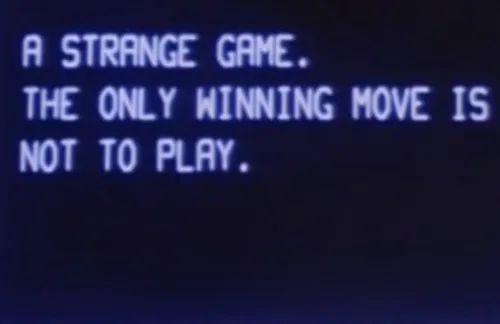
As I like to think that an arhat or a desert father might put it, were they a child of the 80s:

"A strange game. The only winning move is not to play."

First drafted February 2022
Last revised January 2026

21.1 - The Democracy Wager

On choosing regimes from behind the veil

Suppose a stateless wanderer can choose citizenship in one of two unnamed lands.

Only two facts are known: One is a healthy democracy. The other has a thriving free market.

Which should the wanderer choose?

"I just want the most freedom," they say. But how will this be judged? Freedom, of course, means many things, and the importance that we assign to various liberties—freedoms to trade, to move, to speak, and so on—differ widely from person to person.

Suppose, then, that our pilgrim decides to play it safe. Rather than maximize any particular freedom, they choose to minimax, to limit their maximum losses and avoid their worst outcome—namely, the gallows.

Our friend would do well to choose democracy. Stable democracies—formally, at least, governed by political equals—remain the most powerful technology yet devised for protecting individual lives. Experience proves this better than we can explain it; surely much credit goes to liberal rights protections and the liberalizing drift of equal citizenship. Democracies are not infallible. Nor are they more efficient. But their safeguards tend to be most robust.

Laissez-faire, meanwhile, leaves the wayfarer precarious. Any genuinely free market will have norms or rules that allow for predictability in the general run of affairs; without these it wouldn't be a market for long. These rules may be codified into law, but they needn't be. History abounds with examples of commerce beyond state control. General predictability, however, does little to minimize the maximum risks, and these may be very great indeed.

Many a market exists by the grace of a tyrant. How many regimes allow trade only from the end of a leash? However benevolent the despot, however many Chicago economists are consulted, the implicit threat never varies: “Spend and buy what you wish! But only so long as I wish it.”

Happily for our wanderer, of course, democracy and markets can coexist well.

As Robert Dahl noted long ago, every extant democracy is also a market economy.

The opposite does not hold.

First drafted December 2021
Last revised January 2026

22.4 - The Amish Farmers and the Fourth of July

One cheer for the American republic

Rudy and Viola live in a white steel barn. Both are 32. Their six kids—the boys with bowl cuts, the girls in bonnets—play between the clotheslines. The youngest, covered in dust, a boy no older than two, ambles in an umber dress.

I met Rudy and Viola on a walk over the weekend of the Fourth in 2022. My girlfriend Emily and I had gone back to her home in Iowa to celebrate and mourn her mother, who died suddenly not long into the pandemic. The memorial—as with so much of our COVID-era healing—had been postponed. The weather was cool. The clever farmers had planted early this year, and their fields were already high. It was a weekend of consolation and potluck meatballs.

The Amish of my childhood in Missouri lived an hour or so away, and like those in Iowa, were met with a mixture of fascination and contempt. In our world but not of it.

The Amish, like the Mennonites, are a novelty. Americans are rarely more delighted than when they're among Prosperous White People Who Aren’t Like Me. (Rick Steves built a career on this fact.) The Pennsylvania Dutch have built a thriving tourist industry on handicrafts and the homespun. In Cantril, Iowa (pop. 267), just down the road from Emily's farm, the Mennonite-run Dutchman’s Store has swallowed an entire city block and, with shelf after shelf of homesteading goods and local produce, puts any suburban Whole Foods to shame.

But locals are wary. The Amish are no saints, they say: quick to use others’ technology when needed; loathe to pay their taxes (scurrilous urban legend has the IRS treating each of their houses as a church). Those who live in close proximity have none of the tourist's affection. But their work ethic is appreciated, and the rest gets tolerated.

All this would have passed my notice had it not been the weekend of the Fourth of July. Lately, the holiday invites lamentation. Friends on Facebook described how unfitting it felt to fête a country that continues to grind down its women, its immigrants, its gun victims. A cheeky Twitter post from the British Embassy reminded us that we could have been Canada.

What, then, can we say for American goodness? Perhaps only this: That amid all our decay, amid the violence and growing distrust, there exists among our neighbors a society within a society, one that meets with nearly universal toleration. The Amish flourish. Their population has doubled since 2000. In this we find the best of American liberalism: life as you choose it, with whomever you choose.

We will debate which freedoms to require of illiberal communities. We will ask whether a pastoral modus vivendi is any ideal at all.

But it is enough to appreciate its mere existence. Toleration requires laws and an ethos that rarely coincide. Our suspicion of the other sits deep. Even today, rural whites, with homes full of Amish kitsch, show far less friendliness to the Black Americans with whom they have more in common. The lifestyle that Rudy and Viola enjoy depends on neighbors feeling that they're just similar enough.

Still, that the right nomos and ethos have coincided at all; that they’ve coincided here, in a state so ugly to so many; that in America one can not only disagree but also withdraw; we do not appreciate these facts enough. Even on the Fourth of July.

Perhaps other nations have done this better, and perhaps we will do better still.

I wonder that we’ve done it at all.

First drafted June 2022
Last revised March 2026

22.2 - Aristotle's Consolations

On what the Stagirite got right about flourishing

I've too long ignored the wisdom in Aristotle.

I thought the Nicomachean Ethics was antique. Teleology? Please. ”Incontinence”? Heh. The book is dry and disorganized and reads like the lecture notes they are. (Cicero, remarks Plutarch, thought Aristotle’s writing "a river of liquid gold." Cicero had a different edition.)

But hidden within the Ethics is perhaps the greatest study ever written on the elements of a life well-lived. In place of excess it prizes balance. In place of sermonizing we get realism. Those needing advice to clean their room can look elsewhere.


I was prompted to revisit Aristotle by Daniel Kaufman’s excellent essay on Aristotelianism in How to Live a Good Life, edited by Massimo Pigliucci, Skye Cleary, and Kaufman. The chapter emphasizes the human quality of Aristotle’s approach:

The eudaimonic life, for Aristotle, is one in which we have lived to the fullness of our potential; developed our distinctive capacities to their finest points; and accomplished in the world what we have set out to do. It is a life that we should take pleasure in… a life of which a person can be rightly proud. (p. 76)

Aristotle offers a holism that’s missing from more ascetic accounts. The good life for Aristotle is an integrated life. Developing our potential requires work and resources and relationships.

Undergraduates at Brown often got stuck here. Is he really saying that good looks are part of the good life? That money and status are requirements too? That even luck plays a role? Well, yes, at least some modicum of them. I would ask students: Have you tried living without these? None had.

Somehow, amid all our consumption, we nevertheless cling to the belief that happiness needs only the stuff of the soul, that it requires nothing beyond us. Aristotle—and our common sense—shows this to be false. Kaufmann continues:

Far from its dependence on external goods being a defect of Aristotle’s eudaimonism, then, it is one of its greatest strengths, as it reflects a realistic, honest, and mature outlook on life. That effort alone is not enough; that in a fundamental sense I exist among and depend upon others; that social, political, economic, and natural forces are capable of overwhelming and destroying me and the things I have created; that it matters whether or not I actually have succeeded, as opposed to simply having tried to, and that I refuse to deceive myself about this—these are hard truths about our lives and our flourishing. (p. 78)

How strange that a culture like ours, engrossed by our dystopias, would need reminding that environment matters.


I've shopped around wisdom traditions. The Christianity of my youth was poorly suited to solace, solving every problem with prayer or repentance, or both. The indifference of Stoicism was numbing. Epicurus got so very much right but the hedonism felt simplistic. Secular Buddhism and vipassana practice have proved most profitable for me.

Yet with each of these traditions, I've been disquieted by the pull toward a fringe. Stoics miss the richness of human emotions. Traditional Buddhism reserves the purest samadhi for monastics. The Epicureans would have me live in a garden and eat simple food with my friends. No objections there. But what of my duties to others? What of politics and family and love?

And none of these views helped me see beyond the perfectionism that caused me so much pain. Indeed, they inflamed the wound, left me thinking that I could be happy if I were a bit more perfectly committed.

Aristotle takes a different tack. He’s confident that extremism in any direction leads to deficiency elsewhere. Kaufman:

Certainly, we admire the brilliant painter, who has mastered his craft and produces works of extraordinary beauty, but if we discover that he is terrible to his wife and children, crooked in his business, and involved in ugly politics, our estimation of his life, generally, will be poor. That is, while we may continue to admire him as a painter, we will not admire him as a man….

None of this is particularly controversial, but strangely, it becomes so when one shifts the focus to moral virtue, where we find that many esteemed philosophers, as well as ordinary people, suddenly find single-mindedness an admirable trait. (p. 80)

Our great error consists in treating a single virtue as the whole of flourishing. We are undone by our obsessions. We know well the stock examples: the entrepreneur forsaking all in the name of Disruption; the parent who lives for their children; the scholar who can barely tie a shoe. To these the peripatetic has an antidote.

Maybe the good life isn’t a single virtue amplified, but all of the virtues well arrayed.

First drafted January 2022
Last revised January 2026

19.2 - Why Liberals Need Rousseau

On what the Social Contract still teaches

Nearly all of Rousseau’s politics should be rejected.

He adored Sparta. He misunderstood markets and the value of commerce. He gave the “general will” enough shine to seduce generations of revolutionaries, but failed to define it clearly. We can thus forgive Isaiah Berlin for thinking Rousseau “one of the most sinister and most formidable enemies of liberty in the whole history of modern thought” (2002, 52).

There is more to jettison in Rousseau than recover, and this has led many liberals to dismiss Rousseau entirely. They are blameless in this, of course, for if Rousseau has been roundly misunderstood the fault is his alone. His love of paradox has confused centuries of readers. His eloquence has drawn blood.

But we abandon Rousseau at our peril, for what he gets right is exactly what modern liberalism most needs: a model of politics that promotes the common good in service of liberty. In this Rousseau’s claims are consonant with the long line of liberal thinkers, as Helena Rosenblatt has recently shown. Rousseau’s great discovery was that democracy requires a search for the common good. In Rousseau’s hands these ideas are neither platitudinous nor oppressive. The common good—or, if you prefer, mutually beneficial exchange—is the origin of political life. It gives the state its aim and sets its boundaries. It is a good discovered by the people themselves, drawing on local knowledge and the experience of ruling and being ruled. In a moment when liberalism and democracy are in global ebb, and when political society feels riven beyond repair, no theorist is more vital. Rousseau shows friends of liberty how they can promote shared aims without conceding democracy to demagogues or epistocrats.

Rousseau helps us see what we still share.

This essay aims to clarify Rousseau’s conception of the common good and advance an original interpretation of the general will. A future essay will address the second half of Rousseau’s insight, that only democracy in its direct, deliberative form can long preserve liberty.

The Common Good

From Plato to Schumpeter through Brennan or Achen and Bartels, observers have found citizens to be doubly ignorant, struggling to know their good and lacking the expertise to realize it. Rousseau’s genius lies in showing how this ignorance disappears when citizens are asked the right questions in the right way.

Let us distinguish the “common good” from the “greater good” with which it is often confused. The latter is consonant with—and is often drawn from—a utilitarian view toward maximizing the good or welfare of all, whatever sacrifices this requires from individuals. When, for example, those in Omelas want to forcibly torture or kill someone for the greater good, they can do so without compunction.

But the very nature of that sacrifice precludes it from being a good common to all. For Rousseau, government is justified to the extent it promotes exclusively common goods:

[T]he general will alone can guide the forces of the State according to the end for which it was instituted, which is the common good. For if the opposition of private interests made the establishment of societies necessary, it is the agreement of these same interests that made it possible. It is what these different interests have in common that forms the social bond, and if there were not some point at which all the interests are in agreement, no society could exist. (SC 145)

Far from being antithetical to liberal values, then, the common good limits the scope of government to the essential interests we all share. Laws are legitimate when and only when they promote this good—anything more or less is unfreedom. The moment a law favors some at the expense of others, its legitimacy vanishes.

Rousseau is explicit in setting the boundaries of what this good can demand. Even in Political Economy—his earliest wholly political work, and a problematic text for reasons discussed below—Rousseau distances himself from the oblations left open by proto-utilitarian arguments:

[I]sn’t the body of the nation under an engagement to provide for the preservation of the humblest of its members with as much care as for all the others? And is the safety of a citizen any less the common cause than that of the whole state? If someone tells us it is good that a single man should perish for all… I hold this maxim to be one of the most execrable that tyranny ever invented…. Rather than that one ought to perish for all, all have engaged their goods and their lives for the defense of each one among them… (PE 152)

He is more direct still in a footnote to the Social Contract: “…each person is perfectly free with regard to everything that does not harm others. That is the unvarying limit. It cannot be stated with greater precision” (SC 222, original emphasis). Rousseau was never interested in precisely what counted as harm, but his antiharm framing is notable.

We should also distinguish Rousseau’s sociology from his politics. Like nearly all of his contemporaries, Rousseau’s social ideal was republican, praising virtues like honor, public-spiritedness, and love of the fatherland. But by drawing on a popularly derived common good, rather than some vague sense of a public interest or divinely ordered good, Rousseau avoids a common republican pitfall. For Rousseau asserts that bounds exist: no legitimate law will harm some citizens for the good of others. But such assertions are meaningless unless citizens also know what counts as harm, what qualifies as a shared good.

With this in mind, we can see why Rousseau thought it necessary in the Social Contract to offer the first procedural account of collectively defining a common good, exercising a faculty that would become forever tied to his name: the general will.

A Genealogy of the volonté générale

A quarter millennium later and still the general will mystifies. Rousseau’s interpreters may disagree on its meaning, but nearly all have assumed his texts share a single conception of the general will. This is a mistake. For between 1755 and 1762 Rousseau gave the general will competing definitions: in Political Economy it is a transcendent standard of right, while in the Social Contract it is an aim toward a common good discerned through deliberation. In dismissing the former, he reformulated the concept with what appears to be the express intent of preserving liberty.

Rousseau rarely refers to the general will. He cites Rome and Sparta three times as often, and his later projects for Corsica and Poland mention it only once, and there in passing (P 194). In the Social Contract, he argues that the general will alone is the source of legitimate law, and for this will to be expressed, lawmaking must be constrained by three forms of commonality or generality:

  • Generality of source: each citizen states his own opinion in the assembly, and none is excluded from deliberation. (SC 148; 207)
  • Generality of subject: motions considered by the assembly are restricted to matters affecting all. (SC 164; 197; 152-154)
  • Generality of application: the effects of law must privilege none, harm none, and benefit all. (SC 145; 149; 222.)

Laws are legitimate only when this triple-generality constraint obtains, when they are written by the rulers (the people) to promote the interests of all the ruled.

This constraint is new to the Social Contract. Rousseau’s earlier Political Economy had given the general will a completely different aspect, unique in three respects. First, in Political Economy it is a feature of the body politic as a whole: Rousseau never claims that individuals know—or even possess—a general will. Second, deliberation is neither necessary nor sufficient for its expression. The true statesman can himself speak for the vox populi. Third, Rousseau’s chief concern in discussing the general will is that be known to rulers (and may not be necessary even then!).

Political Economy is an epistocratic work, a mirror for the enlightened prince that describes a “talent of reigning” by which a ruler “extends his respectable dominion over wills even more than over actions” (PE 147). Such a man should reshape the will of citizens and “make them what one needs them to be” since at birth citizens must “learn to deserve to live” (PE 155).

We are far here from taking men as they are and laws as they might be, and if these had been Rousseau’s definitive principles, Berlin’s scorn would be warranted.

Thankfully, Political Economy was not Rousseau's final word.

Expressing the General Will

In the Social Contract Rousseau derives the general will entirely from the immanent will of citizens to realize their common good. There is no mystical, transcendent standard of right that must be divined. Consider Rousseau’s thrice-repeated description of how the general will becomes known. The first is found in Book II:

If, when an adequately informed people deliberates, the Citizens were to have no communication among themselves, the general will would always result from the large number of small differences, and the deliberation would always be good. (SC 147)

He summarizes this a few paragraphs later: “In order for the general will to be well expressed, it is therefore important that there be no partial society in the State, and that each Citizen give only his own opinion” (SC 147-148). He restates the idea one last time in Book IV: “Each one expresses his own opinion… by voting, and the declaration of the general will is drawn from the counting of the votes” (SC 201). These lines leave no doubt that the volonté générale is known when—and only when—the people themselves declare it in a collective expression of judgment.
Rousseau says more about this process in showing how “the general will would always result from the large number of small differences” among deliberators:

There is often a great difference between the will of all and the general will. The latter considers only the common interest; the former considers private interest, and is only a sum of private wills. But take away from these same wills the pluses and minuses that cancel each other out, and the remaining sum of the differences is the general will. (SC 147)

This mathematical metaphor is most easily understood from the perspective of participants. Each citizen has two sets of preferences: a “private will” that he should gain at others’ expense, and a “general will” that the good of all is realized. The costlessness of the former will is attractive, but both outcomes conduce to his well-being. Our citizens enter the assembly. Each knows that under conditions of equality, his compatriots would never vote to enact his private will; “If we can’t free-ride,” they would reason, “neither can he.” Seeing that each private will—the “small difference” separating each—is thus removed from the pool of possible outcomes, what remains is a general will. This process demands no altruism; Rousseau’s citizen is still a self-regarding creature. It requires only a well-ordered society in which sovereignty is exercised by an assembly operating under the constraints of generality.

But suppose I hold a minority view on the nature of the shared good. When I am outvoted in the assembly, must I obey? Can I simultaneously “be free and forced to conform to wills that are not [my] own?”

I reply that the question is badly put. The citizen consents to all the laws…. The constant will of all the members of the State is the general will, which makes them citizens and free. When a law is proposed in the assembly of the People, what they are being asked is not whether they approve or reject the proposal, but whether it does or does not conform to the general will that is theirs…. Therefore when the opinion contrary to mine prevails, that proves nothing except that I was mistaken, and what I thought to be the general will was not. (SC 200-201)

The question put to the assembly has a correct answer: will this policy benefit everyone? When the conditions of the general will are in the majority—a crucial condition—and when the question is so posed, the minority simply got it wrong. We might disagree with Rousseau as to whether any questions in politics are of this sort, but the claim is formally sound.

One consequence of this passage is easy to miss: participating in the assembly both expresses and refines my will. Under ideal circumstances, “the common good is clearly apparent everywhere, and requires only good sense to be perceived” (SC 198). But such conditions will rarely (if ever) apply, and I may err in judging the common good, confused by my passions or my isolation from the experience of others. Only deliberation prevents this. This explains the rarely noted line in Book II that “there can never be any assurance that a particular will conforms to the general will until it has been subjected to the free votes of the people” (SC 156). It is only by these lights that I can improve both my will and understanding.

This is Rousseau’s new model of the democratic mind, the “union of understanding and will” so central to his politics. It is in the processes of democratic sovereignty—the assembling, the voting, the deliberation—that we discover our common good and exercise our freedom by willing that good. This is why when I am outvoted, Rousseau explains, if “my private opinion had prevailed… I would have done something other than what I wanted. It is then that I would not have been free” (SC 201). So tightly combined are these concepts that the moment I can no longer discern the good I share with others, I am enslaved.

In sum, Rousseau’s claim is that once a society is well-ordered—that is, once the people have sufficient virtue (ensured by Rousseau’s sociology) and have contracted to abide by their general will—once all this is in place, citizens themselves will decide the boundaries of the common good, in a process that requires both private reflection and the assembled opinions of others.

It is not enough to know that good; it must also be willed.

Conclusion

Liberals need Rousseau for two reasons. The first is that he saw, more clearly than we have seen, that legitimacy demands a search for mutual gain. Second, he understood that this politics of the common good must be built on direct deliberation over fundamental laws. Rousseau always leaned toward aristocratic government, but his Social Contract is built firmly on democratic sovereignty.

John Rawls once remarked that his two principles of justice could “be understood as an effort to spell out the content of the general will.” What Rousseau saw as the outcomes of the general will—personal inviolability, equal influence in public affairs, a state that “needs very few laws” (SC 198)—are recognizably liberal, however anachronistic it would be to apply the label to Rousseau himself, and however much his republican bombast obscures this.

But unlike Rawls, Rousseau’s politics need no veil of ignorance. In taking men as they are, Rousseau described a polity in which rational, pluralistic, self-concerned citizens could come together and choose their laws, pursuing justice by drawing on their experience of liberty and harm.

Even in this Rousseau was not as perceptive as we might wish, for general wills are, in fact, unnecessary to realize a common good. Rousseau’s misguided sociology is as superfluous as it is dangerous. Here writers like Smith and Sophie de Grouchy are far more useful.

But showing this will require separate treatment. It is enough for this essay to suggest that is no mystery or menace in the general will. For all its juridical complexity and its author’s love of paradox, the message of the Social Contract is simple: liberty requires discerning well and willing generally.

Rousseau thus challenges his liberal skeptics: what legitimates law if not a common good? And who can define that good if not citizens themselves?

First drafted March 2019

22.1 - The Unburdening Years

On the hard, slow work of getting over oneself

In the playground of Fair Grove Elementary (Rural District 10) sat what we called the Bell Tower.

It was hardly a tower, standing about as tall as I do now. Its Depression-era bell was long gone. It sat awkwardly among swing sets and monkey bars. But something ancient in all that WPA solidity drew us. It proved a formidable forward base for my imagined Star Trek missions. It also holds my earliest memory of self-creation.

One day, when I was seven or eight, I was standing beside the tower when the cutest girl in my class began walking along a path that would carry her and her friends right past me. Seconds to draw her attention. My big break.

What could I do? She barely knew me, childhood social divisions being what they are. I was the nerdy kid who slipped bits of secondhand Shakespeare into class assignments. She was A.B., all side ponies and neon jackets, as beautiful and fashionable as any.

I weighed my options, chose my gambit, assumed a nonchalance, and waited.

They arrived. I stepped away from the Bell Tower, drew up my hand in a circling, absent-minded motion and said: "E=mc², to the power of three, carry the one…"

And then she was gone.

I threw my arms up in victory. Now they'd know who I was. Now she'd begin to care.

Of course, she hadn't seen me at all.


All my life, I've lived to impress. Every action judged to exceed someone's expectations. No plan undertaken without the promise of showing that I was better than someone else.

I learned early on that I impressed others in my little Missouri farm town for two reasons: I was devout, and I sounded clever.

Devotion naturally sets you apart. I hadn't seen the same movies as friends; I didn't understand their music or cultural memes. This was the mandate, after all—believers were called to be sanctified. In practice, this often meant sanctimony.

Words, like guilt, come quickly to the preacher's son. Linguistic facility has long hidden my sloppy thinking; in writing as in life, a strong voice covers a multitude of sins. Smart words made others think that I was smarter across domains. I began believing this too.

Perhaps there's nothing yet unusual to this story—a small-town, book-bred kid reifies parts of his identity. We all choose something. But something happened when these two traits uncoupled, some slow subduction, worth interrogating. The further that I withdrew from superstition in college, the stronger my need for intellectual distinction. The currency of the church was piety, but the wider world cared nothing for holiness. My old status was worthless. And on arriving in grad school I found that everyone was smart, and that preeminence would demand real effort. It was not enough to simply enjoy my studies, to luxuriate in long seminars on Montaigne or Thucydides. No. Only striving would do. The Pauline way was now closed to me. I would need another route. No longer the saint, I'd play genius instead.

An undiscovered genius, of course, because the world of academia was utterly foreign. This made distinction difficult. The University of Chicago had been unknown to me before my senior year of college. I'd heard of Brown exactly twice before matriculating there: once while watching Iron Man, and once in learning that philosopher Charles Larmore had moved there. A PhD from Brown carries nearly all of the status one could want. But because the aim had become not scholarship but greatness, I was more focused on my rejections.

Soon I began casting around for new distinctions, eventually hitting on the idea of a dual JD/PhD. Again, I got welcomed admissions offers from the name-brand schools. But because I was merely waitlisted at the right school, I dismissed the idea altogether.


It was around this time, circa 2011, when all the threads began coming loose.

By now, I had been weaned on reading the greats, and I wanted to write like they wrote, work on the big problems just like them.[1] I couldn't understand why my powers weren't up to the task, and why my committee wanted me to write boring academic prose like everyone else.

Couldn't they see what I was attempting? Couldn't they see I was different?

The anguish of these questions soon became a full-bore depression that made work impossible. The worst of it—beyond torpor and the bags of chocolate—was watching my old interests fall away. At first you have no willpower to work; soon you wonder why you tried. I wanted to think about anything but political theory. I stayed enrolled in hopes that I'd snap out of it, and because I hadn't seriously considered any other path. By now I'd convinced myself that I was born for this work. It had become my secular calling. What else could I do?

The answer: not much. I left Brown with mountains of debt and that singularly marketable most-of-a-PhD-in-political-theory. In Missouri, I alternated between joblessness and odd jobs and caring for my grandmother. Healing came slowly. Friends were few. All I could see was failure.


But failure at what, exactly? What standard of success was this? Unparallelled erudition? A career that would redefine disciplines?

It wasn't until 2020 that I finally saw how that kid in the playground had gotten lost in thinking that he was his intellect. How his entire self-worth became wrapped up in his ability to become ever more impressive.

2020 had been my best year. I fell in love, moved to the woods, gained some mastery at work. COVID spared me and my loved ones. I could see all this—psychologists would have rated me high in "life satisfaction"—but still I was miserable.

I was adrift in comparisons. First, most obviously, I'd compare myself to other academics, especially the cohort from grad school who'd moved from success to success. Each was doing better work and more work than I'd ever managed. (Never mind that most were unhappy too: unplaced in towns they hated, with colleagues they could mostly tolerate. I couldn't see this at the time.) Yet whatever envy I felt was overwhelmed by regret. I could have had that life. But I'd failed.

The second comparison, a far subtler kind, we might call self-collation. All my adult life I've compared my actual self to the counterfactual man who'd made better choices, or had parents who'd given him Latin, or had been given an even more privileged pedigree. I'd tracked this self from the start of grad school. They split sharply in 2011. By 2021, my better self was all but assured his Nobel.

All this while ignoring that my life wasn't far from the one that I'd said I always wanted: simplicity, decency, quietude. But this had always felt like cornpone Stoicism. Too easy, too low. And besides, it carried none of the status markers on which I'd based my happiness. For what good are comforts if one is not also producing? Should I not be suffering for my art?


Some time-smoothed instinct wants me to leave you with the sense that I've figured it all out: 40 years of ego and then the pure actualization of my true self.

How tidy! How very impressive.

But I haven't figured out much, of course, except that my need for a "true self" was the torment. I kept trying to bend experience around some-or-other narrative, and experience kept snapping back. There is no cosmic self to divine. There's just this clusterfuck of mind and memories and matter. Buddhism's core insight suggests that the mind can't tolerate such a jumble for long, and is always already arranging it into something cohesive that feels like me. Escaping that cycle is the work of a lifetime. But short of that, we can get to the place where we learn to accept the jumble as... pretty okay. To learn that there can be happiness without praise or status. Perhaps even freedom.

This includes freedom to work. For years I'd wonder: if you say you're a writer, why aren't you writing? And the answer, which escaped me until now, was obvious—I'd been held back by a need to be The Writer. Identity killed the activity. It was the same with every pastime; though I thrilled at making images, I abandoned photography because my photos weren't Art. I would be the best or I'd become something else entirely.

You're reading these words because that need for recognition has begun slackening. Not fully disappeared; do even saints manage as much? But loosen. You would be astonished, dear reader, at the amount of puffery I’ve removed from this very essay on being astonishing.[2] I'm sure that much more remains. But progress is progress, and it's enough right now to keep laying down more and more of those playground weights that I've been carrying ever since.

First drafted January 2022
Last revised January 2026


  1. Proust: "My grandmother, as I learned afterwards, had at first chosen Musset's poems, a volume of Rousseau, and Indiana... she did not reflect that the strong breath of genius must have upon the very soul of a child an influence at once more dangerous and less quickening than those of fresh air and country breezes upon his body." ↩︎

  2. The hinge of the problem sits at that single point where playful performance crosses into performative superiority, where the joy of creating lovely little things gets subsumed in the need for recognition and appreciation. The hard thing is that the damned point won't hold still. ↩︎

19.1 - Not Perfect, but Better: Notes From a Nordic Tour

On freedom and fiskefilet

19.1 - Not Perfect, but Better: Notes From a Nordic Tour
Photo by Tommy Kwak / Unsplash

Citizens of Nordic countries lead better public lives than us because they better understand private freedom.

I’ve spent the past few weeks traveling the region to study what Henrik Berggren and Lars Trägårdh have called “statist individualism,” a distinctly Nordic approach by which the state guarantees personal autonomy. On this view, we shouldn’t be forced to depend on spouses or parents or children or neighbors for a decent life. Such dependence makes us less free. How to prevent this? Let the state ensure provision of necessary goods.

In my many conversations with locals about this, the overwhelming response was bewilderment: why ask about something so obviously correct? Isn’t that everyone’s view? Isn’t that what Americans believe?

Nordic folks are proud of their state. They brag about it. Even the tacky “Hop On, Hop Off” buses discuss welfare policies. Imagine! Sure, locals acknowledge the high taxes, but they do so no differently than any expensive investment with a good return. (Incentives still matter, of course—Sweden’s national pastime is crossing borders for cheaper booze.)

The libertarian critic will find here dependence of a different sort, and will ask whether depending on the state is any better than on friends and family. What of government dysfunction? Couldn’t markets do better? And here too, the Nordic countries are remarkably pragmatic, from Sweden’s universal school voucher system to Norway’s public-private ownership of roads. The point isn’t that all these goods must be state-provided, but instead must be state-guaranteed.

And isn’t that better than Americans begging neighbors to help pay for cancer treatments? Than millennials relying on parents well into adulthood for housing or health insurance?

Humans will be dependent. That’s the nature of social life. The question for liberal societies is whether to bear that dependence individually or collectively. Nordic countries have found a way to do the latter, and do it well.

After 18 days—not long, but long enough for basic observations—I left the region with two impressions.

First, the Nordic peoples are almost certainly the freest on Earth, largely because they’re better defended against threats of “want” and “fear.” Set aside your theoretical understanding of liberty and just look at the lives of the average Finn or Norwegian. Are not they freer than us?

Second, the Nordic countries have a grasp on the common good that’s lacking in the English world. It’s precisely the common good I’ve been pondering these past few years: not a greater good that means sacrificing one’s own interests for the whole, but the sense that when we protect the autonomy of each, we create forms of public life that promote, rather than invade, our freedom.

(And lest you think this is simply a theorist’s wish-fulfillment: the orientation film at the Danish Architecture Center—not exactly a treatise on political thought—invokes the “common good” no less than three times.)

This encourages taking the long view of politics. No surprise that Greta Thunberg is Swedish—sustainability is everywhere. Future generations have agency. And when the status quo isn’t working, it gets changed: state programs that were wasteful in the 70s and 80s were cut back; when the Swedish parliament decided that its bicameral structure was inefficient, they just… changed it.

I’ve no illusions here: Scandinavians aren’t a race of altruists. Their politics still have conflict. They care just as much about their own interests as we do. But they also recognize that many of our interests are best guaranteed socially, rather than individually, and this grounds their distinct approach to the res publica.

Nordic politics aren’t perfect, but they are better.

The usual American reflex to all this? “What works there wouldn’t work here” someone told me a few years ago, with complete confidence, as if the characters of peoples and polities are fixed for all time. They’re small countries, we’re told. Homogenous populations. High social trust. They live on potatoes and pickled fish. What have they to teach Greatest and Freest Nation on Earth™?

We’re not so different as it might seem. True, Nordic countries are among the most trusting, but we’ve no reason to believe they’ve passed some magic threshold beyond our reach. And at least some of that trust is driven by the strong welfare state and the reciprocity it fosters. As one Danish immigrant put it to me, “the state puts me through college and then I pay to do the same for others.”

Not long ago Americans trusted each other like Scandinavians do now. What changed? Too many causes to mention, but it doesn’t help that one of our parties is committed to—thrives on—anti-government rhetoric, whatever the costs. Conservatives work to cripple welfare programs and then bemoan their ineffectiveness. “See, the state doesn’t work!” says the Republican who’s just thrown gravel into the gears.

What about ethnic homogeneity? It’s a mistake to compare any one Nordic country to the entire United States, but comparisons to individual states are revealing: all but five states have foreign-born populations smaller than Sweden’s 19%. Our diversity isn’t what’s holding us back.

And those taxes? Sure, they’re high, but not that much higher than what you pay. And when you consider everything those taxes provide—excellent health care, a lifetime’s education, generous parental leave, daycare, nursing home care, and so on—they start to look like a bargain, especially for the middle class. Most Americans would end up with more disposable income.

Again, not perfect, but better.

In short, the Nordics have moved one to two generations beyond us in building a free and fair and modern society. Fly from any major American airport to a comparable Nordic tarmac. Walk through the modern, sustainably designed airport. Take the cheap train downtown. Observe the families—so many families—and the bikes and the shops and greenery. Pay close attention, and you’ll find humans just like us doing a better job building lives of stability and fulfillment.

This isn’t socialism. Instead it’s the fullest expression of liberal values yet attempted.

I’ve seen in these countries nothing—no mindset or habits or social institutions—incompatible with American ideals. We, too, take pride in our independence, our love of liberty and equal opportunity. But our definitions of these concepts, and our attendant skepticism toward state activity, need updating, since the American model creates great precarity where none is needed. Ed Miliband was right: in this century, “if you want the American dream, go to Finland.”

The Nordics are proof that we needn’t fear the democratic state. Both governments and markets can make us less free; both can promote autonomy. More important than the mechanisms by which we foster independence is our drive to do so, for everyone. Which is why there’s no magic in the Nordic model—just a commitment to individuals and their flourishing. Americans would do well to pay attention.

Written June 2019

Subscribe to The Novice

Only the good stuff. Delivered for free.